




A shroom trip typically lasts 4-6 hours, though your experience can range from 3-8 hours depending on dosage, metabolism, and mushroom potency. You’ll feel the onset within 20-40 minutes, hit peak intensity around 1.5-3 hours in, and gradually return to baseline by hour 6-8. Psilocybin converts to psilocin in your liver, driving these effects until clearance. Understanding each phase of the timeline helps you navigate exactly what your body and mind will go through.
How Long Does a Shroom Trip Actually Last?
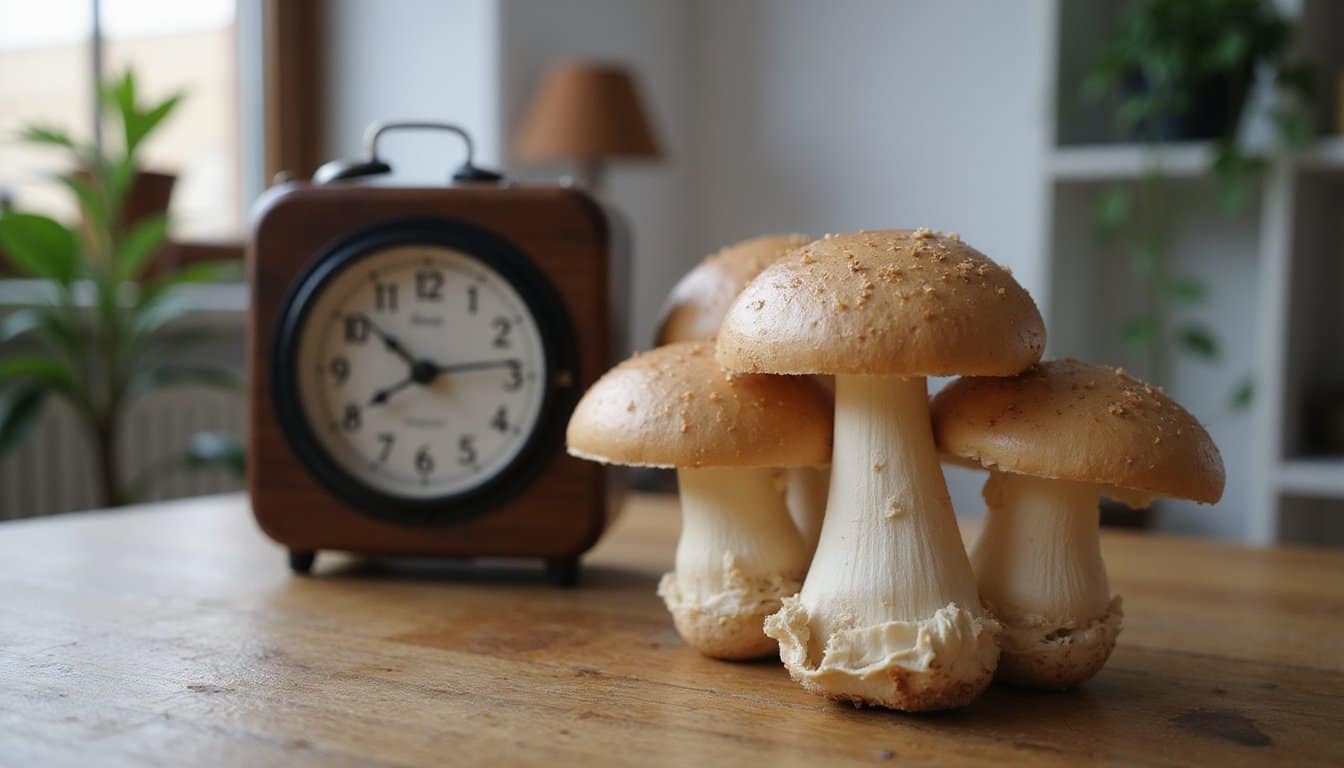
Most shroom trips last between 4 and 6 hours, though the full range spans 3 to 8 hours depending on dosage, metabolism, and individual physiology. Your shroom trip duration shifts based on how quickly your body converts psilocybin into psilocin, the active compound driving effects.
The psilocybin experience unfolds across distinct psychedelic trip stages. Onset typically occurs within 30 to 60 minutes post-ingestion. Peak intensity concentrates between 1.5 and 3 hours, where perceptual distortions and emotional amplification are most pronounced. The comedown phase adds another 2 to 4 hours as effects gradually taper.
Higher doses exceeding 3.5 grams push total duration toward 8 hours. Residual effects, including fatigue and mild sensory changes, can persist up to 24 hours after the primary experience concludes. Among all variables, dosage remains the most significant factor determining how long and intense the overall experience will be.
What Are the Four Phases of a Shroom Trip?
A shroom trip unfolds in four distinct phases, beginning with onset roughly 20, 40 minutes after ingestion and progressing into the come-up, where you’ll notice intensified colors, emotional amplification, and visual distortions. The peak hits between 1.5 and 3 hours post-ingestion, delivering the most immersive psychedelic effects, including maximum hallucinations, time distortion, and pronounced cognitive alterations. From there, you enter the comedown phase, which begins around 4, 6 hours in and gradually returns you to baseline over the following 2, 4 hours as visual effects soften and emotional intensity fades. How fully each phase unfolds is shaped by factors like dose, mindset, and environment, meaning no two experiences are identical.
Onset to Peak Progression
When you consume psilocybin mushrooms, the experience unfolds across four distinct phases: onset, build-up, peak, and comedown. Understanding onset phase characteristics helps set accurate expectations. Effects begin 20, 40 minutes post-ingestion as psilocybin converts to psilocin, producing mild nausea, restlessness, and early sensory shifts. An empty stomach accelerates this to 20, 30 minutes.
Build-up phase progression spans 1, 2 hours post-ingestion. During this window, psilocin binds to serotonin receptors, intensifying visual enhancement, time distortion, and emerging emotional shifts.
Peak phase timing occurs 1.5, 3 hours post-ingestion, where hallucinations, cognitive alterations, and emotional shifts reach maximum intensity. This peak persists 2, 3 hours before declining. Higher doses, potent strains, and faster consumption methods extend both peak intensity and duration.
The comedown and afterglow phase spans 2, 4 hours as the experience gradually returns to baseline. During this phase, psilocin’s half-life averages around 3 hours regardless of dose, which is why the total experience typically concludes within 4, 8 hours rather than extending indefinitely.
Comedown and Resolution Phase
As the peak intensity subsides, the comedown phase begins around 3, 5 hours post-ingestion and extends the total trip duration to 4, 6 hours, with some experiences reaching up to 8 hours. During this window, psilocin half-life ranges between 1.23, 4.72 hours, explaining the gradual decline in perceptual and emotional intensity. Visual effects soften first, followed by physical fatigue, normalized body temperature, and subsiding nausea. You’ll likely notice emotional waves becoming gentler, often accompanied by contentment, relief, or introspective clarity. As resolution approaches, an afterglow period lasting 6, 24 hours may produce mild sensory enhancements and perspective shifts. Mental exhaustion commonly replaces active introspection, and cognitive fatigue or residual sensations can persist into the following day, particularly with higher doses.
What Happens During the Peak of a Shroom Trip?

The peak of a shroom trip typically hits between 2, 3 hours after ingestion, coinciding with maximum plasma psilocybin concentrations in the body. During this window, you’ll experience the most intense effects of the entire trip.
The shroom trip peak strikes hardest at 2, 3 hours in, when psilocybin plasma levels hit their ceiling.
- Visual distortions, Geometric patterns, color saturation, and altered depth perception reach maximum intensity
- Perceptual warping, All sensory inputs amplify, heightening your awareness of environmental stimuli
- Emotional amplification, Mood states intensify dramatically, producing profound introspective waves
- Ego dissolution, At higher doses (3+ grams), you may temporarily lose individual identity boundaries, experiencing unity with your surroundings
This peak phase typically lasts 1, 3 hours, with effects maintaining strong intensity for approximately 2, 4 hours depending on dosage and individual sensitivity.
What Factors Make Your Shroom Trip Shorter or Longer?
While the peak experience unfolds with predictable intensity, how long your entire trip lasts depends on several interacting variables. Dosage is the primary driver. A 1g dose produces a light 3, 6 hour experience, while 3.5g or more extends effects to 6, 8 hours. Higher dosage prolongs peak immersion rather than total duration, since psilocin’s half-life averages 3 hours regardless of amount consumed.
Potency matters equally. Stronger mushroom strains accelerate psilocybin-to-psilocin conversion, deepening the peak without proportionally extending overall length. Effects plateau beyond 3.5g due to 5-HT2A receptor saturation.
Your metabolism and body composition also shape the timeline. Faster metabolizers experience onset within 20 minutes, while slower metabolizers may wait 60 minutes. Body type influences how quickly your system clears psilocin post-peak.
When Do Shroom Effects Start to Wear Off?

Most shroom trips begin winding down around the 3, 5 hour mark after ingestion, when peak intensity starts giving way to a gradual decline. Understanding your psilocybin trip timeline helps you recognize where you are in the process.
Most shroom trips begin winding down at the 3, 5 hour mark, as peak intensity gradually gives way to decline.
Key wear-off indicators in a magic mushroom trip include:
- Peak intensity drops after 2, 3 hours post-ingestion
- Visual distortions begin fading around the 4-hour mark
- Physical sensations subside between 5, 6 hours
- Baseline consciousness returns by 6, 8 hours
Knowing how long do shroom trips last matters clinically and personally. Fatigue and emotional reflection typically emerge during this phase. Full resolution usually completes within 6, 8 hours, with an afterglow period potentially extending mild sensory changes up to 24 hours.
How Long Does Psilocybin Stay in Your System After a Trip?
Even after your trip ends, psilocybin’s metabolite psilocin continues circulating in your system, with a half-life of approximately 50 minutes and full clearance from the bloodstream occurring within 5, 6 hours. How long detection remains possible depends on the testing method used, ranging from under 12 hours in saliva to up to 90 days in hair samples. Several factors, including your metabolism speed, body composition, and usage frequency, directly influence how quickly psilocybin and its metabolites clear from your system.
Psilocin Half-Life Explained
Once the psychedelic effects of psilocybin begin to fade, your body has already been working to clear its active metabolite, psilocin, from the bloodstream. Understanding psilocin’s half-life helps explain mushroom trip length and why effects diminish predictably. how long does a shroom trip last can vary depending on several factors including dosage, individual metabolism, and set and setting. Generally, these trips can last anywhere from four to six hours, but the peak experience is often concentrated within the first two to three hours. Understanding these time frames can enhance your preparation and allow for a more informed experience.
Key pharmacokinetic benchmarks include:
- Oral half-life: 2.1, 4.7 hours, with variability ranging up to 18.6 hours
- IV administration half-life: Approximately 1.2 hours, confirming route substantially impacts clearance
- 50% elimination: Occurs after one complete half-life cycle
- Full clearance: Most psilocin clears within 4, 6 hours post-peak
These figures directly correlate with how long does a shroom trip last for most individuals. Your liver converts psilocybin into psilocin rapidly, and your kidneys handle predominant excretion, making metabolic health a critical variable in elimination speed.
Detection Window by Test
Knowing how long psilocin stays active in your body is one thing, but knowing how long it remains detectable is a separate question with real practical implications. Detection windows vary enormously by testing method. Urine tests can detect psilocin up to 24 hours, with specialized panels extending that window to 3, 5 days. Blood testing typically clears within 5, 6 hours for psilocin, though psilocybin itself may persist up to 15 hours. Saliva detection spans 12, 24 hours maximum. Hair follicle testing offers the longest window at up to 90 days, though it requires expensive LC-MS/MS technology. Importantly, standard 5- or 10-panel drug tests don’t screen for psilocybin at all. Routine testing is rare since specialized equipment, narrow detection windows, and low misuse rates make widespread screening impractical.
Factors Affecting Clearance
Several biological and physiological variables determine how quickly your body clears psilocybin after a trip ends. Your liver converts psilocybin into psilocin, and its efficiency directly shapes elimination speed.
Key clearance factors include:
- Metabolism rate, Faster metabolism clears psilocin quicker; slower metabolism retains metabolites longer.
- Dosage, Higher doses extend metabolization time and prolong peak plasma concentrations near the 2-hour mark.
- Body composition, Higher body fat percentage retains metabolites longer, while greater body mass with adequate hydration supports faster elimination.
- Liver health and hydration, Liver disease considerably prolongs clearance, while proper hydration marginally supports processing; approximately 65% of psilocybin exits through urine within 15 hours.
Understanding these variables helps explain why clearance timelines differ considerably between individuals.
What Are the Signs Your Shroom Trip Is Finally Ending?
As a shroom trip winds down, the signs of its conclusion follow a fairly predictable sequence rooted in the drug’s pharmacological timeline. Around the 3, 5 hour mark, visual distortions and intense emotions begin fading noticeably. You’ll find disorientation replaced by introspection, and ego shifts typically dissolve by hour four.
Physically, nausea from the onset fully resolves during the comedown, while fatigue becomes prominent after six hours. Mental clarity gradually returns between hours four and six, signaling the core trip’s conclusion.
For higher doses, full resolution may extend to 6, 8 hours. You might notice lingering mild sensory enhancements and a reflective afterglow persisting up to 24 hours. These residual effects are normal and distinct from active trip symptoms requiring clinical concern.
Your Journey to Wellness Starts Now
Frequently Asked Questions
Can You Stop a Shroom Trip Early if It Becomes Overwhelming?
You can’t fully stop a shroom trip once it’s started, as psilocin binds to serotonin receptors and has roughly a 50-minute half-life, making rapid clearance impossible. However, you can reduce intensity by changing to a calm environment, practicing breathing exercises, staying hydrated, and having a sober trip sitter present. If you experience severe panic or psychosis lasting beyond 6 hours, seek professional medical help immediately.
Is It Safe to Sleep During an Active Shroom Trip?
Sleeping during an active shroom trip isn’t safe or likely achievable. Psilocybin binds to serotonin receptors, elevating alertness and heart rate while producing intense visuals that worsen in dark environments. You’re particularly vulnerable during the 1.5, 3 hour peak, where ego dissolution and emotional intensity heighten anxiety risks. Nausea during onset also increases choking hazards. You should wait until the comedown phase, typically after 4, 6 hours, before attempting rest.
Does Combining Mushrooms With Food Change the Overall Experience Intensity?
Yes, combining mushrooms with food does change your experience intensity. Eating beforehand slows psilocybin absorption, producing milder, more prolonged effects while reducing nausea from chitin irritation. Conversely, consuming on an empty stomach accelerates absorption, intensifying euphoria and hallucinations. Food also lowers your risk of gastrointestinal distress, including vomiting and bloating. However, psychological factors like anxiety can amplify perceived intensity regardless of what you’ve eaten beforehand.
Can a Shroom Trip Trigger Lasting Psychological Effects After It Ends?
Yes, a shroom trip can trigger lasting psychological effects after it ends. You may experience prolonged anxiety, depression, or paranoia, with research showing 24% of users reporting persistent symptoms. You’re also at risk for HPPD, where visual disturbances continue post-trip. However, you can also gain lasting therapeutic benefits, including reduced depression and anxiety. Your pre-existing mental health history, dosage, and access to proper aftercare considerably influence whether your lasting effects are harmful or beneficial.
How Does a First-Time Trip Differ From Experienced User Experiences?
If you’re a first-timer, you’ll likely experience delayed onset up to 60 minutes, overwhelming visuals, and intense emotional waves peaking around 2-3 hours. Your total trip may extend 6-8 hours with prolonged afterglow and next-day fatigue. Experienced users, however, report faster onset within 20-40 minutes, manageable hallucinations, deeper introspection, and predictable comedowns lasting 4-6 hours. Tolerance buildup allows veterans to navigate the experience with considerably less anxiety and physical discomfort.