







You can trace the Twelve Steps to Akron, Ohio. There, stockbroker Bill Wilson met surgeon Dr. Bob Smith on June 10, 1935, A.A.’s recognized founding date. Drawing on the Oxford Group, early members shared six oral principles, including honesty and making amends. Wilson expanded them into twelve steps, and they first appeared in print in April 1939’s Big Book. If you’ve wondered how two struggling men sparked a worldwide movement, there’s more to their story ahead.
Key Takeaways
- The Twelve-Step program began in Akron, Ohio, when stockbroker Bill Wilson met surgeon Dr. Bob Smith on June 10, 1935.
- Influenced by the Christian Oxford Group, early members shared six oral principles, including admitting defeat, honesty, making amends, and helping others.
- Wilson expanded these principles into twelve steps, first published in the 1939 Big Book, which placed them at its center.
- Alcoholics Anonymous spread from Akron and New York to Cleveland, Canada, and worldwide, adopting the Twelve Traditions in 1950.
- Other fellowships later adapted the Twelve-Step model for other addictions, while its core of peer support remained unchanged.
How did the 12-step program begin

The Twelve-Step program began in Akron, Ohio, in 1935, when New York stockbroker Bill Wilson met Akron surgeon Dr. Bob Smith. Both men struggled with alcoholism, and A.A. recognizes June 10, 1935, as its founding date. Today, Twelve-Step fellowships span the globe. Influenced by the Oxford Group, a Christian movement, early members shared six oral principles, including admitting defeat, honesty, making amends, helping others, and prayer. Wilson expanded those ideas into twelve steps in the late 1930s, drawing on members’ discussions. The turning point in 12-step program history came in April 1939, when the Big Book first published the steps for struggling readers.
How did AA grow from two men into a global movement
A.A. grew from two men into a global movement through members in Akron and New York who helped one another stay sober, which spread the program beyond its first two groups, and a Cleveland group formed in 1939.
You can trace that growth to a few deliberate choices. In 1938, Wilson and Smith organized a trusteeship, and the 1939 Big Book carried their message to readers they’d never meet.
| Year | Milestone |
|---|---|
| 1938 | Founders organized a trusteeship |
| 1939 | Big Book published; Cleveland group forms |
| 1950 | Twelve Traditions formally adopted |
From there, A.A. reached Canada and then other countries worldwide. If you’ve struggled, you’ll recognize why it worked: members relied on trusted servants, not governing authorities. That decentralized spirit remains central to the history of the 12 steps, and you’ll still find it guiding groups today.
Who founded Alcoholics Anonymous and when

Bill Wilson, a New York stockbroker, and Dr. Bob Smith, an Akron surgeon, founded Alcoholics Anonymous after meeting in Akron, Ohio, in 1935. Both men had struggled with alcoholism, and their meeting sparked what you now know as A.A.
The founding unfolded in these steps:
- June 10, 1935: A.A. recognizes this date as its official founding.
- Shared struggle: Wilson and Smith discovered that people with alcoholism could help one another stay sober.
- Early expansion: Groups formed in Akron and New York, and a Cleveland group emerged in 1939.
The Oxford Group, a Christian movement stressing spiritual change and personal accountability, shaped their early thinking. Still, the founders didn’t copy it. They built A.A.’s own identity through member discussion, laying groundwork you’ll recognize in today’s recovery.
How was the Big Book written
The Big Book grew out of a group effort. During the late 1930s, Bill Wilson expanded early A.A. recovery principles into twelve steps, and early members debated and contributed ideas, shaping the steps through discussion, so you’re reading a group effort rather than one man’s vision. Those principles had first passed along by word of mouth, often as six ideas: admitting defeat, honesty, making amends, helping others, and prayer. In April 1939, they published *Alcoholics Anonymous*, which you’ll know as the Big Book. It placed the Twelve Steps at its center and paired guidance with personal recovery stories from people who’d lived through alcoholism. Those stories let you hear real struggles, and publication carried A.A.’s approach beyond Akron and New York.
How did the 12 steps spread beyond alcohol
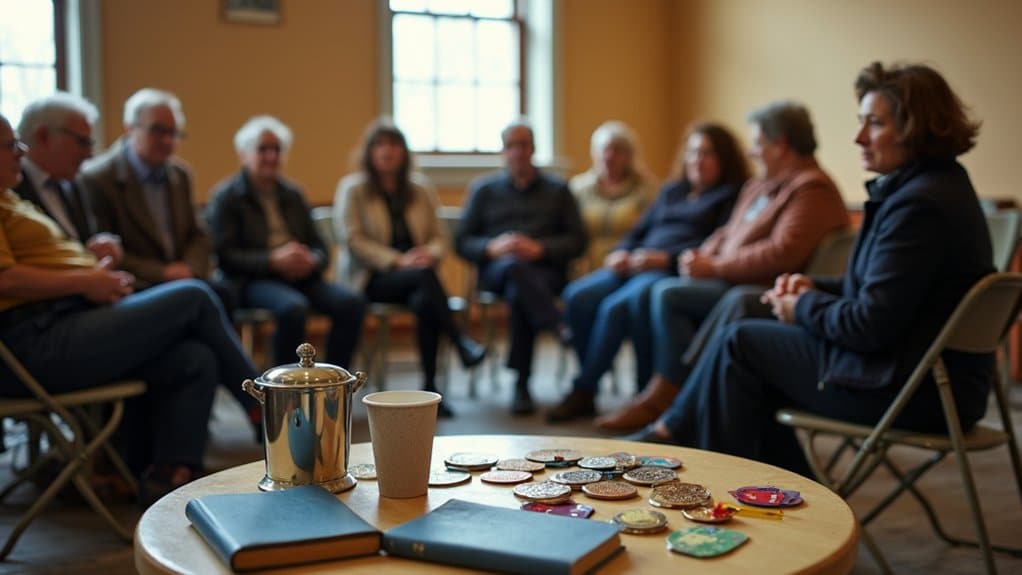
Other fellowships adapted A.A.’s Twelve-Step model for other addictions and compulsive behaviors. The Twelve Steps first appeared in print in the 1939 Big Book, giving A.A. a written program that could travel without its founders. As groups spread from the United States to Canada and then overseas, A.A. became the first widely recognized Twelve-Step fellowship.
If you’ve joined one of these fellowships, you’ve likely met these shared elements:
- Peer support, where you lean on people who’ve faced the same struggle.
- Personal reflection and amends, which help you take honest inventory and repair harm.
- Service to others, so you strengthen your recovery by helping someone else.
A.A.’s lasting legacy is that it popularized a peer-led recovery model grounded in the experience members share with one another.
What has changed and what has stayed the same
A.A.’s core of shared peer support and the Twelve Steps has stayed the same, while the structure around it has changed. You’ll still find the Twelve Steps, first published in the 1939 Big Book, at the center of recovery, even though A.A. has grown far beyond the Akron living rooms where it began in 1935. You’re still asked to admit powerlessness, take personal inventory, make amends, and help others, just as early members did when they shared six principles orally.
The founders stepped away from the Oxford Group, organized a trusteeship in 1938, and watched groups spread from Akron and New York to Cleveland, Canada, and beyond. In 1950, the Twelve Traditions gave you trusted servants instead of governing authorities. Other fellowships later adapted the model, yet shared peer support remains its beating heart.
Why does the original model still shape treatment today
A.A.’s original model still shapes treatment today because it showed that people with alcoholism can sustain sobriety by helping one another, and that principle remains central wherever recovery depends on shared experience. The founders’ 1935 meeting in Akron proved that peers could sustain sobriety together, and the 1939 Big Book carried that lesson beyond local groups. Today, you’ll still see three original elements at work:
- Peer support: You don’t recover alone. Members who’ve struggled share what’s worked for them.
- Personal reflection and amends: You take inventory, admit wrongs, and repair relationships, just as the 1939 steps outlined.
- Service to others: You strengthen your own sobriety by helping someone else find theirs.
The 1950 Traditions also kept leadership decentralized, so later fellowships could adapt A.A.’s model to other addictions and behaviors without losing its peer-led foundation.
Explore 12-Step Support for Lasting Recovery
The Twelve Steps have helped shape addiction recovery for generations, but lasting progress often requires more than peer support alone. Villa Wellness Center offers structured addiction treatment, including 12-step program education that combines recovery principles with clinical care. Verify your insurance to explore your coverage options, or call (844) 609-3035 to learn how to get started.
Frequently Asked Questions
Do You Have to Be Religious to Join a 12-Step Program?
No, you don’t have to be religious, though you’ll notice spiritual roots. In 1935, A.A.’s founders drew on the Oxford Group, a Christian movement, but they moved away from its approach as the fellowship built its own identity. The 1939 Big Book’s Twelve Steps emphasize spiritual reflection, not a specific faith. By 1950, the Traditions favored trusted servants over authorities, so you’ll find shared experience and peer support guiding you.
What Is a Sponsor, and How Do You Find One?
A sponsor’s an experienced member who’s worked the steps and guides you through them one-on-one. Your sources don’t detail sponsorship, but they show its roots: in 1935, Bill Wilson and Dr. Bob Smith stayed sober by helping each other, and that peer support still drives the model. To find one, you’ll attend meetings, listen for someone whose recovery resonates, and ask. It’s okay to feel nervous; most members say yes.
What Happens During a Typical 12-Step Meeting?
At a typical meeting, you’ll join peers who help one another stay sober, a practice A.A. members began in 1935. You’ll hear people share their own experience, much like the recovery stories in 1939’s Big Book. You’ll often discuss the Twelve Steps, from admitting powerlessness to making amends. Trusted servants, not bosses, guide the group under the 1950 Traditions. You don’t have to speak; you’re always welcome to just listen.
Do 12-Step Programs Charge Membership Fees or Dues?
No, you won’t pay membership fees or dues in A.A. or most 12-step groups, though the provided history doesn’t address finances directly. Groups typically pass a basket for voluntary contributions, and you’re never required to give. That fits A.A.’s roots: founded in 1935, organized under a 1938 trusteeship, and guided since 1950 by the Twelve Traditions, which favor trusted servants over governing authorities. You’re always welcome, contribution or not.
How Long Does It Usually Take to Work Through All Twelve Steps?
There’s no set timeline, and the history you’re exploring doesn’t specify one. What it does show is how the steps took shape: early members shared six principles orally, Bill Wilson expanded them into twelve in the late 1930s, and the Big Book published them in April 1939. Since you’ll move through powerlessness, inventory, amends, and service at your own pace, it’s okay if your journey takes longer than you’d expected.